
Scaffolding has been used for thousands of years to help workers reach elevated areas during construction, maintenance, and decoration. However, the scaffolding systems used today are very different from the simple wooden structures and ropes used in ancient times.
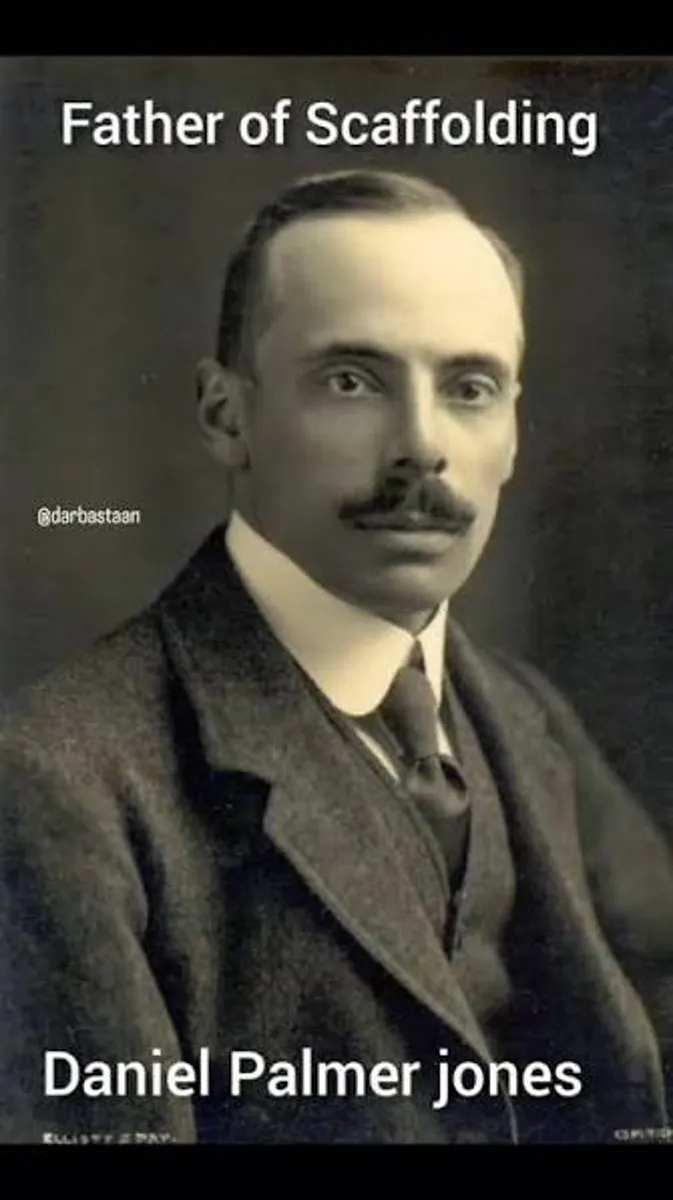
One of the most important figures in the development of modern scaffolding was Daniel Palmer-Jones, a British inventor and engineer who, together with his brother David Henry Jones, developed innovative systems for connecting and securing scaffold components.
Their inventions helped transform scaffolding from relatively basic structures into more standardized, practical, and secure systems.
Who Was Daniel Palmer-Jones?
Daniel Palmer-Jones was an English inventor associated with the development of early modern scaffolding systems in the early twentieth century. His work focused particularly on improving the way scaffold poles could be connected and secured.
At that time, scaffolding construction often relied on ropes and other traditional methods. These techniques could make assembly slower and produce structures with less standardization.
Palmer-Jones and his brother David Henry Jones worked on solutions that could provide stronger and more efficient connections between scaffold components. Their work eventually became highly influential in the scaffolding industry.
The Scaffixer: A Major Step in Scaffolding Development
One of the best-known innovations associated with the Jones brothers was the Scaffixer, a device designed to connect scaffold poles more efficiently than traditional rope-based methods.
The Science Museum Group has a Scaffixer block in its collection and identifies it as a Jones patent from either 1907 or 1910. The device was manufactured by the Patent Rapid Scaffold Tie Company in Westminster, London.
The importance of the Scaffixer was not simply the component itself. It represented a broader change in scaffolding technology: moving toward standardized metal components and mechanical connections.
This development made it easier to assemble scaffolding structures and contributed to the evolution of the systems used by professional scaffolders today.
Palmer-Jones and Scaffold Pole Connections
In 1910, Daniel Palmer Jones filed a patent for a system for connecting scaffolding poles. The patent was granted in the United States in 1911.
The patent describes a device designed to connect scaffold poles and replace rope-based tying methods, with the goal of making scaffolding erection faster and safer.
This invention demonstrates how Palmer-Jones was working not merely on individual scaffold components but on improving the overall process of assembling scaffolding.
The Universal Coupler
Another important development associated with Daniel Palmer-Jones was the evolution of scaffold clamps and couplers.
A later patent by Daniel Palmer-Jones, filed in 1921 and granted in 1923, describes an improved scaffolding clamp for connecting scaffold members.
The development of these mechanical connections was extremely important because modern scaffolding depends on reliable connections between tubes, braces, platforms, and other structural elements.
Some historical sources also associate Palmer-Jones with the development of the Universal Coupler, which became an important part of tubular scaffolding systems.
The Buckingham Palace Connection
One of the notable moments in the history of the Jones brothers occurred in 1913, when they were involved in repair work at Buckingham Palace.
Their scaffolding technology gained significant attention during this project, helping demonstrate the practical advantages of their approach to scaffold construction.
The project helped increase awareness of their scaffolding systems and contributed to their reputation within the construction industry.
Why Palmer-Jones Is Important to Modern Scaffolding
It would be inaccurate to say that Daniel Palmer-Jones invented scaffolding itself. Scaffolding had existed in many forms for thousands of years.
His importance lies in helping develop modern tubular scaffolding and mechanical connection systems.
The Jones brothers helped move the industry away from traditional methods based heavily on timber and rope toward standardized metal tubes and mechanical couplers.
This transition improved the practicality, repeatability, and structural organization of scaffolding systems.
From Traditional Scaffolding to Modern Systems
Before the widespread adoption of tubular metal scaffolding, many temporary structures were assembled using wooden poles and ropes.
The introduction of standardized metal components created new possibilities. Tubes could be connected using specialized couplers, allowing scaffold structures to be configured for different buildings and working conditions.
The work of Daniel Palmer-Jones and David Henry Jones therefore represents an important stage in the broader industrialization of scaffolding.
Modern scaffolding has continued to evolve with improvements in materials, engineering, safety standards, modular systems, and manufacturing technology. However, the basic principle of connecting standardized components remains fundamental to many scaffolding systems.
Conclusion
Daniel Palmer-Jones was not the inventor of scaffolding itself. Instead, he was one of the important pioneers who helped shape modern scaffolding technology.
Together with David Henry Jones, he developed innovative methods for connecting scaffold poles and components, including the Scaffixer and later improvements to scaffold clamps and couplers. Historical patent records and museum collections document several of these developments.
For this reason, Palmer-Jones is often described as one of the fathers of modern scaffolding. His work helped establish the principles of standardized tubular scaffolding and mechanical connections that remain central to the industry today.

💬 نظرات کاربران
اولین نفری باشید که نظر میدهد.