
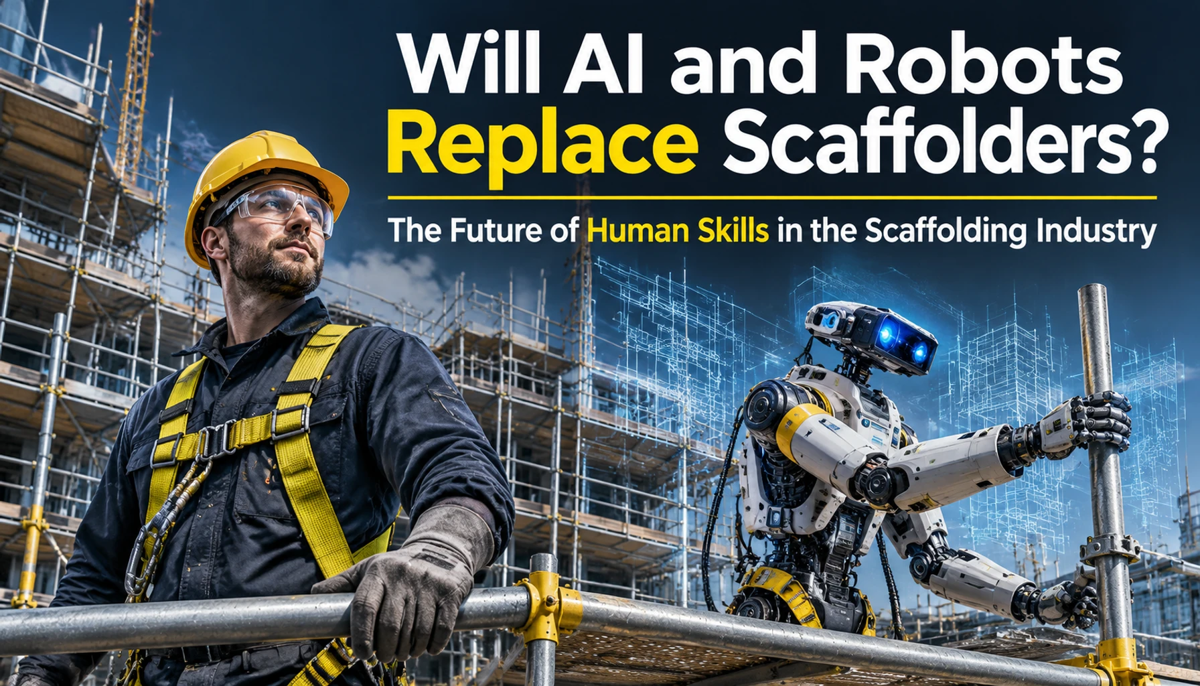
Will AI and Robots Replace Scaffolders? The Future of Human Skills in the Scaffolding Industry
Artificial intelligence and robotics are changing the construction industry. From automated machinery and smart planning systems to robots capable of handling heavy materials, technology is creating new possibilities for how construction work is carried out.
But what does this mean for the scaffolding industry?
Could robots eventually replace scaffolders? Will artificial intelligence take over parts of the job? Or will these technologies simply change the way scaffolders work?
These are no longer questions limited to science fiction. They are becoming part of real conversations among scaffolders, contractors and construction professionals.
At Darbastan and ScaffDigital, we have been listening to scaffolders from different countries and collecting their opinions about the future of their profession. Some believe robots could replace scaffolders sooner than we expect. Others argue that the knowledge, experience and practical judgement required for scaffolding cannot easily be replicated by machines.
So, what is likely to happen?
1. AI Can Help Plan Scaffolding, But Can It Replace Experience?
Artificial intelligence could become a valuable tool in scaffolding design and planning.
AI-assisted software may help with:
- Analysing project requirements
- Supporting scaffold design and planning
- Estimating material quantities
- Identifying potential design conflicts
- Improving project coordination
- Supporting risk assessments
These tools could save time and help companies make better decisions.
However, planning a scaffold is not simply a matter of calculating dimensions or selecting components.
Every construction site is different. Ground conditions, access restrictions, existing structures, weather, other trades and unexpected obstacles can all affect how a scaffold must be built.
An experienced scaffolder understands that real construction sites rarely follow a perfect plan.
Technology can support decision-making, but practical experience remains essential when conditions change.
2. Robots Could Take Over Some of the Hardest Tasks
One of the biggest challenges in scaffolding is the physical work involved.
Loading, unloading, carrying and handling heavy materials can put considerable strain on workers' bodies. Repeated manual handling over many years can contribute to injuries and long-term physical problems.
This is where robotics and automation could make a real difference.
Robotic material-handling systems, lifting equipment and automated transport solutions could help:
- Move heavy scaffolding components
- Reduce repetitive manual handling
- Improve material transportation on site
- Reduce physical strain on workers
- Support safer and more efficient operations
Technologies such as KEWAZO's LIFTBOT demonstrate the direction in which material handling in construction is developing.
But there is an important distinction: helping scaffolders move materials is not the same as replacing the people who build the scaffold.
In many situations, technology may be more valuable as a way to make the job safer and less physically demanding.
3. Why Complex Scaffolding Still Requires Human Skills
A scaffold is not always a standard structure assembled from a simple set of instructions.
Industrial projects, refineries, power stations, bridges and complex buildings can require highly specialised scaffolding solutions.
Scaffolders may need to deal with:
- Unusual structural configurations
- Restricted access
- Different levels and working heights
- Obstacles and existing equipment
- Complex connections and support arrangements
- Unexpected changes during construction
These situations require more than physical strength.
They demand spatial awareness, practical knowledge, problem-solving and the ability to make decisions in changing conditions.
One experienced scaffolder can recognise a potential problem that someone with less experience might overlook.
Can a robot eventually perform some of these tasks? Possibly.
But developing a machine that can safely understand and respond to every unpredictable situation on a construction site is a much greater challenge than automating a repetitive task in a controlled environment.
4. What Scaffolders Around the World Are Saying
In our discussions with scaffolders, the subject of automation and artificial intelligence has already appeared.
Some workers believe that robots will eventually take over much of the physical work. Others are more sceptical, pointing out that scaffolding requires practical skills and experience that cannot simply be replaced by technology.
There is also another side to the discussion.
Many scaffolders have spoken about physical exhaustion, injuries, low wages and the difficulty of attracting younger people into the trade.
This raises an important question:
If technology can reduce the hardest and most repetitive parts of scaffolding, could it actually make the profession more attractive to the next generation?
Instead of seeing automation only as a threat to jobs, perhaps we should also consider its potential to improve working conditions.
These comments represent the personal experiences and opinions of people who interact with our platforms. They are not a representative survey of the global scaffolding workforce, but they provide valuable insight into the concerns and expectations of workers.
5. Could Robots Help Solve the Scaffolder Shortage?
The scaffolding industry has another challenge: attracting and retaining skilled workers.
In our previous discussions about whether scaffolders are becoming a dying breed, many workers raised concerns about low pay, physically demanding conditions, limited career progression and a lack of proper training.
Some experienced scaffolders also worry that practical knowledge is not being passed on effectively to younger workers.
Automation could help address part of this problem.
If machines take over some repetitive lifting and material-handling tasks, scaffolders could spend more time on skilled activities, planning, inspection and complex installations.
However, technology cannot solve every workforce problem.
The industry will still need people who understand scaffolding, receive proper training and can take responsibility for safe construction.
Robots may reduce the physical workload, but they cannot automatically create experienced scaffolders.
6. The Biggest Risk: Losing Skills and Experience
There is another question that deserves attention.
If companies become increasingly dependent on automated systems, could practical scaffolding knowledge gradually decline?
Scaffolding is a trade where much of the knowledge is developed through real work, observation and learning from experienced colleagues.
Understanding how structures behave, recognising unsafe conditions, choosing suitable solutions and working effectively as a team all require practical experience.
Technology should support this knowledge, not replace the process of developing it.
The next generation of scaffolders will need to understand both traditional scaffolding skills and new technologies.
The most valuable professionals may be those who can combine practical experience with the ability to work alongside advanced equipment and digital tools.
7. Will AI and Robots Replace Scaffolders?
The most realistic future may not be a construction site filled with robots working entirely without people.
Instead, we may see a gradual transformation of the profession.
AI could support planning and calculations. Robots could assist with material handling. Automated equipment could reduce repetitive and physically demanding tasks.
Meanwhile, human workers would continue to handle complex installations, solve unexpected problems, make practical decisions and ensure that work is carried out safely.
Of course, technology will continue to develop, and some tasks currently performed by scaffolders may eventually become automated.
But replacing an entire profession is very different from automating individual tasks.
The future of scaffolding will depend not only on what technology can do, but also on safety requirements, costs, practical limitations and the willingness of companies to invest in new systems.
Final Thoughts: Technology Should Support Scaffolders, Not Undermine Them
The scaffolding industry should not be afraid of technology, but it should understand how to use it properly.
Robotics and artificial intelligence could help reduce physical strain, improve efficiency and support safer working conditions.
At the same time, the industry must continue investing in training, experience, mentoring and professional development.
A robot may be able to lift a scaffold component. AI may help calculate a structure. But developing the judgement and practical knowledge required to build complex scaffolding safely remains a serious challenge.
Perhaps the most important question is not whether robots will replace scaffolders.
It is whether the industry will use technology to create a better future for the people who work in it.
We Want to Hear From You
We want to hear from scaffolders, contractors, company owners and construction professionals around the world.
- Do you think AI and robots will eventually replace scaffolders?
- Which scaffolding tasks should be automated first?
- Would you trust a robot to assemble a complex scaffold?
- Could technology make scaffolding safer and more attractive to young workers?
- Will the next generation of scaffolders need to be skilled tradespeople, technology operators, or both?
Share your experience, tell us which country you work in and join the discussion.
Darbastan × ScaffDigital — Giving Scaffolders Around the World a Voice.

💬 نظرات کاربران
اولین نفری باشید که نظر میدهد.