
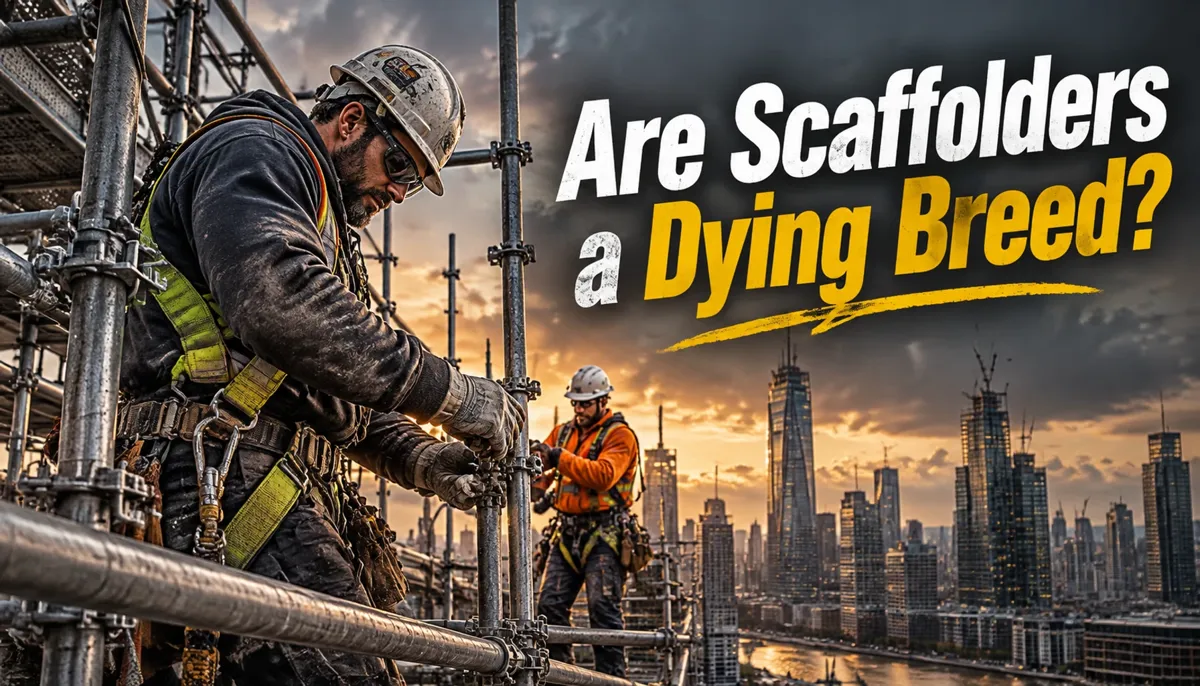
Are We Losing the Next Generation of Scaffolders? And If So, What Is Driving Experienced Workers Away from the Trade?
The scaffolding industry has always depended on practical skills, experience, teamwork and knowledge passed down from one generation to the next.
From residential construction sites to major industrial projects, scaffolders play an essential role in keeping construction and maintenance work moving safely.
But an important question is increasingly being raised by people working in the industry:
Are scaffolders becoming a dying breed?
To explore this question, we started listening to scaffolders from different countries, asking them about their careers, working conditions, training, wages and expectations for the future.
Their responses revealed several recurring concerns. Although their experiences differ, many of the same challenges appear across different parts of the industry.
Let's take a closer look.
1. Low Pay, High Risk: Is Scaffolding Worth It?
One of the most frequently mentioned concerns is the gap between the risks involved in scaffolding and the wages workers receive.
Scaffolders regularly work at height, handle heavy materials, face difficult weather conditions and carry significant responsibility for the safety of others.
Yet many experienced workers believe their pay does not reflect the physical demands, technical knowledge and risks associated with the job.
One scaffolder with 50 years of experience shared that wages were better 30 years ago and have failed to keep pace with inflation and other trades.
Another worker explained that after completing a three-year apprenticeship and gaining seven years of experience, they were still earning the same as someone on their first day in the industry.
These experiences raise an important question:
Why should someone invest years developing professional skills if those skills are not reflected in their pay?
When experience and responsibility bring little financial reward, it becomes harder to motivate workers to stay and progress.
2. The Physical and Mental Cost of Scaffolding
Scaffolding is physically demanding work.
Carrying tubes, moving boards, handling fittings, climbing structures and working long hours can place considerable strain on the body.
The effects are not always immediate. Years of repetitive physical work can take a toll on shoulders, knees, hips and backs.
Some experienced scaffolders have shared stories of serious physical problems after decades in the trade.
One worker approaching 53 years of age said his shoulders were already badly damaged.
Another experienced scaffolder described how, after 32 years in the industry, even climbing two metres had started to make him nervous.
These comments highlight something that is sometimes overlooked:
The cost of scaffolding is not measured only in working hours. It can also be measured in long-term health.
Improving working conditions, reducing unnecessary manual handling and protecting workers' long-term health must be part of the industry's future.
3. Where Are the Next Generation of Scaffolders?
A recurring concern among experienced scaffolders is the difficulty of attracting and retaining young workers.
Some believe younger people are less willing to accept the physical demands and challenging conditions associated with scaffolding.
However, blaming the younger generation alone does not explain the whole problem.
Young people entering the workforce are also comparing career opportunities.
They want fair wages, job security, opportunities to progress and a reasonable balance between work and personal life.
If another trade offers better pay, less physical strain or clearer career progression, why would someone choose scaffolding?
The industry needs to ask itself a more important question:
Are we giving young people enough reasons to choose scaffolding as a long-term career?
Attracting the next generation requires more than telling young workers to work harder. It requires creating a profession in which they can see a future.
4. Experience vs. Certification: Are We Losing Practical Skills?
Another major concern raised by experienced scaffolders is the difference between holding a qualification and actually knowing how to build scaffolding.
Several workers have questioned whether some training programmes provide enough practical experience to prepare people for real construction sites.
One experienced scaffolder argued that only a small proportion of workers in his workplace could handle complex, high-risk scaffolding structures.
Others highlighted the importance of learning directly from experienced scaffolders who understand the practical challenges of the job.
A qualification is important. It provides a foundation of knowledge and helps establish minimum standards.
But practical experience, problem-solving, understanding different structures and knowing how to work safely in challenging situations take time to develop.
A scaffolding certificate may demonstrate that someone has completed training, but becoming a skilled scaffolder requires much more.
The industry needs effective training systems that combine theoretical knowledge, practical assessments and proper mentoring.
5. The Disappearing Old-School Scaffolder
Perhaps one of the most concerning themes in our discussions is the potential loss of traditional scaffolding knowledge.
Experienced scaffolders often describe a time when skills were passed directly from one generation to another.
New workers learned by watching, listening, asking questions and working alongside experienced professionals.
Some believe that this culture of mentoring and teamwork is becoming weaker.
There are also concerns about younger workers being less interested in learning complex skills or developing beyond basic scaffolding tasks.
However, experienced workers also have a responsibility to pass on what they know.
If skilled scaffolders leave the industry without sharing their knowledge, valuable experience can disappear with them.
Traditional Tube & Fitting skills, complex scaffold construction, problem-solving and practical knowledge should not be lost simply because the industry is changing.
Experience is one of the industry's most valuable assets. It must be transferred, not replaced.
6. Working Conditions, Communication and Teamwork
Scaffolding is rarely an individual job. It depends on coordination, trust and communication between team members.
Some scaffolders have raised concerns about difficult working environments, inconsistent supervision and communication problems between workers.
For example, one German scaffolder explained that new workers regularly join his team but some speak very little German or English.
He described them as hardworking and good people, but said language differences sometimes make communication more complicated.
On a construction site, communication is not simply about making work easier. It can directly affect safety.
Clear instructions, shared safety procedures and effective teamwork are essential, particularly when working at height.
As international workforces become increasingly diverse, companies need to consider better communication, multilingual safety information and appropriate training.
7. Lack of Recognition and Career Progression
Many experienced scaffolders feel that their knowledge and contribution are not properly recognised.
Some have spent decades developing their skills but see little difference in pay or opportunities compared with less experienced workers.
Others have described leaving scaffolding for different careers because they could not see a future in the industry.
This is particularly important when considering the next generation.
A career should offer opportunities to develop, specialise, take on greater responsibility and earn better wages.
Scaffolders who develop advanced skills should have a clear path towards becoming supervisors, inspectors, instructors or specialists in complex scaffolding.
Without meaningful progression, the industry risks losing some of its most experienced people.
8. Can Technology Help Shape the Future?
Technology is also changing the construction industry.
Robotics, mechanical lifting systems and new material-handling solutions are being developed to reduce manual handling and improve productivity.
Some scaffolders joke that AI-powered robots will eventually replace them.
But the future may be more about supporting scaffolders than replacing them.
Scaffolding involves constantly changing environments, complex structures, practical decisions and coordination between workers.
Technology could help reduce physically demanding tasks, improve efficiency and make certain operations safer.
However, these solutions must also be affordable and practical for scaffolding companies of different sizes.
The challenge is to use technology to improve the profession while preserving the knowledge and skills that make experienced scaffolders valuable.
So, Are Scaffolders a Dying Breed?
The comments we received do not prove that scaffolders are disappearing worldwide. They represent personal experiences and opinions from workers in different countries, not a statistically representative global survey.
But they reveal something important.
Many scaffolders are passionate about their profession. Some have spent decades in the industry and cannot imagine doing anything else.
Others love the challenge, the teamwork and the satisfaction of building something that allows other trades to work safely.
Yet passion alone cannot solve low wages, physical exhaustion, poor working conditions, inadequate training or limited career progression.
If the industry wants to attract the next generation, it must also give experienced workers reasons to stay.
The future of scaffolding depends on recognising the value of the people who build it.
We need to reward experience, improve training, protect workers' health, strengthen mentoring and create better career opportunities.
The question is not simply whether young people want to become scaffolders.
It is whether the industry is giving them enough reasons to do so.
We Want to Hear Your Story
Are you an experienced scaffolder? Have you recently entered the trade? Or have you already left the industry?
We want to hear from scaffolders around the world.
- How many years have you worked in scaffolding?
- Would you recommend this profession to the next generation?
- What is the biggest problem facing scaffolders in your country?
- What needs to change to make scaffolding a better career?
Share your experience and help us understand the future of our industry.
Every scaffolder has a story. Every experience matters.
Darbastan × ScaffDigital — Giving Scaffolders Around the World a Voice.

💬 نظرات کاربران
اولین نفری باشید که نظر میدهد.