
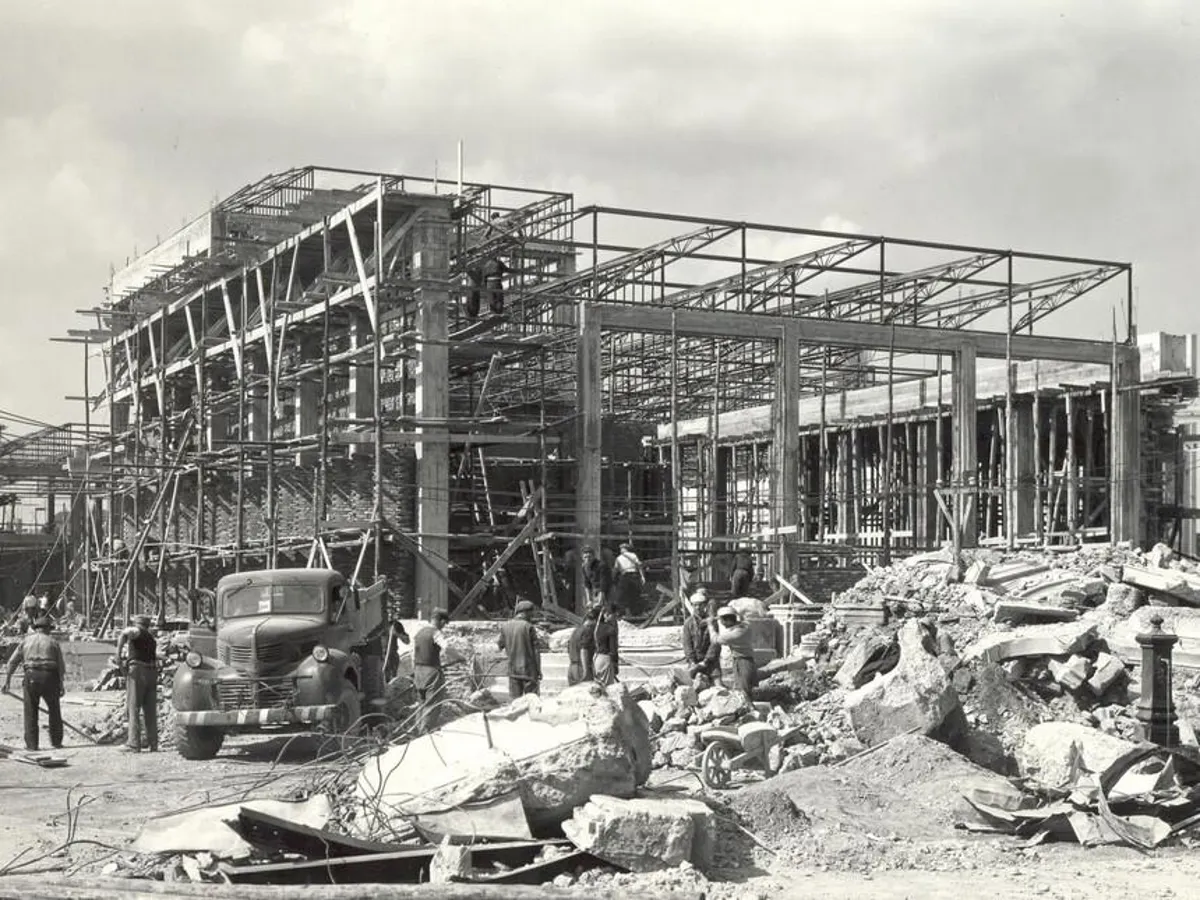
Introduction: A New Era for the Global Scaffolding Industry
The Second World War left much of Europe facing an enormous reconstruction challenge. Residential buildings, factories, bridges, railway infrastructure, and public facilities had to be repaired or rebuilt. The scale of the work created an urgent need for construction methods that were faster, more efficient, and safer than many traditional techniques.
Although scaffolding had been used for centuries, the post-war period helped accelerate its transformation into a more standardized industrial system. Timber poles and rope connections gradually gave way to reusable steel tubes, engineered connections, prefabricated frames, and modular components.
This transformation did not happen overnight, nor was it caused by a single invention. Instead, it emerged from decades of technical development, growing construction demand, manufacturing improvements, and increasing attention to worker safety.
The reconstruction era became an important turning point in the history of the scaffolding industry, helping establish many of the principles that continue to shape modern scaffolding systems today.
1. Europe’s Reconstruction Created an Unprecedented Demand for Scaffolding
After 1945, countries across Europe faced the challenge of restoring damaged cities while addressing shortages of housing and industrial facilities.
Construction companies needed equipment that could be assembled quickly, dismantled efficiently, transported between projects, and reused multiple times.
Traditional timber scaffolding remained useful, but it often required substantial preparation, manual cutting, and tying. These methods could be time-consuming, especially on large construction sites where hundreds of workers and multiple trades operated simultaneously.
Steel scaffolding offered an increasingly practical alternative. Standardized tubes, metal couplers, and prefabricated components made it possible to assemble temporary access structures with greater consistency.
The growing demand for reconstruction therefore supported the wider adoption of industrially manufactured scaffolding equipment.
According to the technical history published by Techniques de l’Ingénieur, post-war reconstruction and subsequent European integration contributed to the development of scaffolding systems that were more resistant, easier to handle, and safer.
2. From Traditional Timber to Steel Tube Scaffolding
One of the most important developments in scaffolding history was the transition from traditional timber structures to reusable metal components.
For centuries, scaffolders relied on timber poles, wooden platforms, ropes, and other locally available materials. These systems could be adapted to different buildings, but their performance depended heavily on the materials, connections, and skills available on site.
During the early twentieth century, steel tubes and mechanical couplers introduced a different approach.
Instead of relying primarily on rope connections, scaffolders could connect metal tubes using purpose-designed fittings. This made it possible to create adaptable structures using repeatable components.
Daniel Palmer-Jones and his brother David Henry Jones were important figures in the development of modern British scaffolding. Their work on metal fittings and more standardized connections helped establish the foundations of modern tube-and-coupler scaffolding before the post-war reconstruction boom.
The reconstruction period did not invent steel scaffolding. Rather, the growing demand for construction capacity helped accelerate the industrialization and wider use of technologies that had already begun to emerge.
Why Steel Scaffolding Became So Important
Steel scaffolding offered several practical advantages:
- Reusability: Tubes and fittings could be dismantled and used on subsequent projects.
- Adaptability: Different arrangements could accommodate a wide variety of building shapes.
- Standardization: Manufactured components made it easier to repeat established configurations.
- Durability: Properly maintained steel components could serve across many construction cycles.
- Construction efficiency: Reusable components reduced the need to manufacture an entirely new temporary structure for every project.
These advantages made steel scaffolding particularly valuable for large reconstruction programs and increasingly industrialized construction sites.
3. The Rise of Modular Scaffolding Systems
The next major development was the movement from individual tubes and couplers toward more integrated scaffolding systems.
In traditional tube-and-coupler scaffolding, workers connect individual tubes using separate fittings. This provides considerable flexibility, but assembling complex structures can require considerable experience, careful planning, and substantial labor.
Modular scaffolding introduced components with built-in connection points or prefabricated frames. These systems were designed to simplify assembly and create more repeatable arrangements.
A study of scaffolding development published through the European Centre for the Development of Vocational Training identifies the development of an SGB frame access system in 1944 and the growing use of system scaffolding from the 1950s onward.
This chronology illustrates how the shift toward standardized equipment began around the end of the war and continued through the following decades.
How Modular Scaffolding Changed Construction
Modular systems helped make scaffolding more systematic.
Instead of treating every scaffold as an entirely individual arrangement of tubes and fittings, manufacturers could supply coordinated sets of components designed to work together.
This approach offered several benefits:
- Faster assembly for suitable, repetitive applications.
- More predictable component arrangements.
- Easier planning for common façade and access configurations.
- Improved compatibility within a manufacturer's system.
- More consistent installation procedures when supported by appropriate training and supervision.
However, modular scaffolding did not eliminate the need for engineering judgment. Complex geometry, unusual loading conditions, wind exposure, and specialized industrial applications can still require detailed design.
The industry evolved toward a combination of flexibility and standardization rather than replacing every traditional scaffolding method with a single universal system.
4. The Development of Prefabricated Frames and Standardized Components
As construction became increasingly industrialized, manufacturers began developing equipment intended to reduce repetitive work on site.
Prefabricated frames and coordinated components allowed scaffolding contractors to assemble familiar arrangements from manufactured parts rather than building every section from individual tubes.
This development was especially useful for repetitive façade work, housing projects, industrial maintenance, and large commercial buildings.
Germany became an important center of post-war scaffolding development. Layher, founded in 1945, later introduced its SpeedyScaf façade system in 1965 and its Allround modular system in 1974.
These milestones demonstrate that the evolution of modern scaffolding continued well beyond the immediate reconstruction period.
The industry moved progressively toward specialized product families, integrated connection systems, and equipment designed around particular construction tasks.
Standardization also made it easier for contractors to plan equipment inventories, train workers on familiar components, and reuse compatible equipment across projects.
Nevertheless, compatibility should never be assumed between different manufacturers' systems. Components must be used according to the applicable specifications and approved configurations.
5. How Post-War Reconstruction Influenced Scaffolding Safety
The expansion of construction activity also highlighted the risks associated with working at height.
Scaffolding accidents can result from unstable foundations, inadequate bracing, overloading, defective components, unsafe platforms, or insufficient protection against falls.
As construction methods evolved, safety increasingly became an essential part of scaffolding design, installation, inspection, and worker training.
Historical accounts of twentieth-century scaffolding describe the wider adoption of measures such as guardrails, controlled work areas, and improved fall protection during the post-war decades.
However, the development of safety standards differed between countries. It would be inaccurate to attribute modern scaffolding safety regulations to a single post-war initiative.
In the United States, for example, the Occupational Safety and Health Administration adopted scaffolding standards in 1971 and later revised them. In Europe, technical standardization developed through national frameworks and subsequent efforts toward harmonized European requirements.
These developments helped move scaffolding safety beyond reliance on individual experience alone.
Why Safety Became Central to Modern Scaffolding
Modern scaffolding safety depends on several interconnected factors:
- Structural stability: The scaffold must be designed and erected for the intended loads and conditions.
- Safe access: Workers need suitable access routes and working platforms.
- Fall protection: Guardrails and other protective measures must be selected according to the applicable requirements.
- Inspection: Components and completed structures must be checked for defects and unsafe conditions.
- Training: Workers must understand the equipment, installation procedures, and site-specific risks.
The important historical change was not simply the introduction of stronger materials. It was the gradual recognition that equipment design, work procedures, and safety management must function together.
6. Scaffolding Became an International Industry
Post-war reconstruction was concentrated in particular regions, but the industrialization of scaffolding had implications far beyond Europe.
Manufacturers developed increasingly specialized equipment, while construction companies required temporary access systems for bridges, factories, power stations, shipyards, and high-rise buildings.
Over time, manufacturers established distinct approaches to scaffolding design.
Some systems emphasized the flexibility of individual tubes and couplers. Others used frames or integrated modular connections to simplify assembly for particular applications.
Italy also made an important contribution to this history. In 1934, Ferdinando Innocenti patented a distinctive coupling device for steel tubes. Research by Ilaria Giannetti at the University of Rome Tor Vergata documents how the Innocenti system subsequently became important in Italian construction, including major reinforced-concrete and infrastructure projects during the post-war decades.
This example shows that the development of modern scaffolding was not exclusively a British or German story. Different countries contributed technologies that responded to their own construction practices, industrial capabilities, and infrastructure needs.
By the second half of the twentieth century, scaffolding had developed into a specialized international industry serving increasingly complex construction and maintenance projects.
7. The Lasting Impact of the Reconstruction Era on Modern Scaffolding
Today's scaffolding industry is the result of many overlapping developments rather than a single invention.
The post-war reconstruction era helped accelerate the demand for reusable components, standardized equipment, specialized manufacturing, and more systematic safety practices.
Several characteristics of modern scaffolding reflect this longer historical transformation.
Reusable Equipment
Modern scaffolding systems are designed around components that can be dismantled, inspected, maintained, and reused when they remain fit for service.
Modular Design
Many contemporary systems use integrated connection points or prefabricated components that support repeatable assembly configurations.
Specialized Applications
Scaffolding is now used in a broad range of environments, including building façades, industrial plants, bridges, marine facilities, and infrastructure maintenance.
Engineering and Safety Management
Modern projects increasingly rely on defined load requirements, installation procedures, inspections, technical documentation, and competent supervision.
These features emerged over many decades. The reconstruction period was an important catalyst, but subsequent technological advances, national regulations, international standards, and industry experience continued to shape the equipment used today.
Conclusion: How Reconstruction Helped Shape Modern Scaffolding
The reconstruction of Europe after the Second World War created an extraordinary demand for construction capacity. That demand helped accelerate the transition toward reusable steel components, prefabricated frames, modular systems, and more systematic approaches to safety.
The roots of these technologies often predated 1945, while many of their most recognizable developments took place during the following decades.
From early tube-and-coupler innovations to the growth of modular systems, the history of scaffolding reflects a broader transformation in the construction industry: temporary structures became increasingly engineered, standardized, and specialized.
Understanding this history helps explain why modern scaffolding is much more than a temporary platform around a building. It is an essential construction system shaped by generations of technical innovation, industrial development, and efforts to make work at height safer and more efficient.
Frequently Asked Questions (FAQ)
How did World War II affect the scaffolding industry?
The post-war reconstruction effort increased demand for construction equipment and efficient building methods. This helped accelerate the adoption of reusable steel scaffolding, standardized components, and more systematic construction practices.
When did modern steel scaffolding begin to develop?
Modern steel tube-and-coupler scaffolding developed during the early twentieth century. Innovations associated with Daniel Palmer-Jones and David Henry Jones helped establish important foundations before the post-war expansion of the industry.
What is modular scaffolding?
Modular scaffolding uses coordinated components with integrated connection points or prefabricated frames. These features can simplify assembly for suitable applications while maintaining the need for correct design and installation.
Why did scaffolding safety standards become increasingly important?
As construction activity expanded, the risks associated with working at height became increasingly significant. Safety measures, training, inspection procedures, and regulatory frameworks developed over time to address these hazards.
Who contributed to the development of modern scaffolding?
Important contributors include Daniel Palmer-Jones and David Henry Jones in Britain, Ferdinando Innocenti in Italy, and manufacturers such as Layher in Germany. Their contributions formed part of a much broader international history of scaffolding innovation
Historical Sources and Further Reading
- Techniques de l’Ingénieur — Scaffolding History and Regulations
https://www.techniques-ingenieur.fr/en/resources/article/ti262/scaffolding-history-and-regulations-tba600/v2 - European Centre for the Development of Vocational Training (CEDEFOP) — Development of Scaffolding
https://www.cedefop.europa.eu/files/4.1_clarke_winch.pdf - University of Rome Tor Vergata — Tubular Steel Scaffolding for Italian Fascist Propaganda (1935–43)
https://art.torvergata.it/handle/2108/345978 - Occupational Safety and Health Administration (OSHA) — Scaffolding Frequently Asked Questions
https://www.osha.gov/etools/scaffolding/faqs - Layher — Company Milestones
https://www.layher.com/en/company/milestones
These sources provide historical, technical, and regulatory context for understanding how scaffolding evolved during the twentieth century.

💬 نظرات کاربران
اولین نفری باشید که نظر میدهد.